
Compromise and Corruption

Reading Revelation Before We Apply It
As we continue examining how White Christian nationalism has infiltrated American evangelical and Pentecostal communities through the lens of the seven churches in Revelation, it helps to pause to consider something essential about John’s book: There has never been universal agreement on how to read it, and most of us have been exposed to only one or two interpretations.
For two thousand years, Bible scholars have approached Revelation through four major interpretive lenses—each offering a distinct way of understanding what John saw and what it means for the church today. And most use Revelation 1:19 as their starting point. Write therefore the things that you have seen, those that are and those that are to take place after this. (ESV)
Four Ways Christians Have Read Revelation
1. Preterism
Preterists understand most of Revelation as having been fulfilled in the first century. In this view, the book is primarily a theological interpretation of events surrounding the fall of Jerusalem in AD 70 and the destruction of the Temple by Rome. Revelation is therefore considered history, rather than prophecy.
2. Historicism
Historicists read Revelation as a symbolic outline of church history from the apostolic age to the return of Jesus. The seven churches are understood as representing successive eras of the Church. This approach has largely fallen out of favor in modern scholarship.
3. Idealism
Idealists—also called symbolic, allegorical, or non-literal interpreters—view Revelation as a poetic portrayal of dualism, the timeless struggle between good and evil. Rather than mapping the book onto specific historical events, they emphasize enduring spiritual truths that apply to believers in every age. Revelation, in this view, is not primarily about when things happen, but about what is always happening beneath the surface of history.
4. Futurism
Futurists generally interpret Revelation literally and believe most of its events have not yet occurred. Futurism entered mainstream Protestantism in the early nineteenth century.
This view dominates popular evangelical teaching today and is associated with figures such as J. N. Darby, C. I. Scofield, John Walvoord, Hal Lindsey, Jack Van Impe, and David Jeremiah, as well as with many Baptist, Pentecostal, and nondenominational churches.
Appealing to Revelation 1:19, futurists divide the book into three sections:
Chapter 1: what John saw
Chapters 2–3: the things which are—the present church age
Chapters 4–22: future events leading up to Christ’s return
The Lens We Use
Most contemporary scholars adopt a hybrid approach, often blending Idealism with a restrained form of Preterism. This allows Revelation to speak both to its original audience and to the Church across time, without forcing the text into speculative timelines or political blueprints.
That is the approach I will use here.
The seven churches were real congregations, facing real pressures, temptations, and compromises. Yet their stories echo forward. They expose recurring patterns of faithfulness and failure—patterns that are particularly relevant as we examine how political power, national identity, and religious language are being fused in the modern American church.
Those who truly understand their faith recognize that white Christian nationalism is heresy. If we act now, we may still halt our swift slide into authoritarianism. I hope these essays will inspire us to take that crucial step using non-violent means.
Many evangelicals, Pentecostals and “Christmas” Christians have been seduced by the heresy, and our president is using their support to fuel the chaos and cruelty of this administration.
The three congregations we will examine here are Smyrna, Pergamum, and Thyatira from Revelation 2:8-29. I will summarize, but encourage you to read it for yourself.
Smyrna: Poor, but Rich
Smyrna was an economically distressed congregation that was rich in faith. Jesus found no fault in that church and encouraged them with, “The one who conquers will not be hurt by the second death.” From Smyrna, we learn the importance remaining faithful.
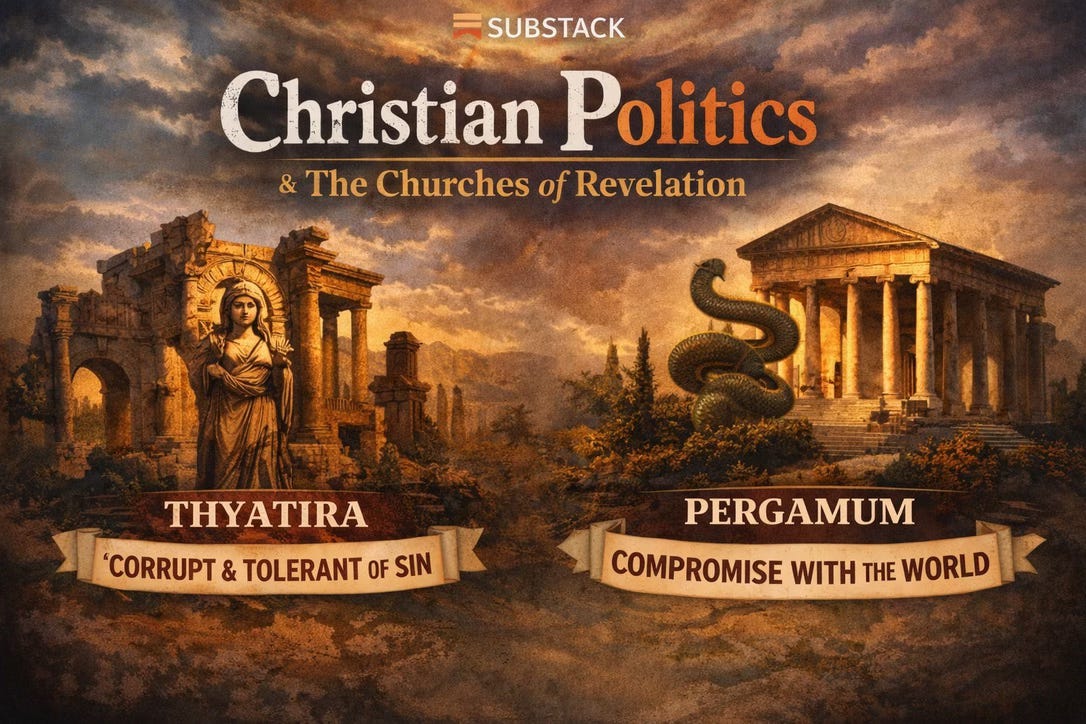
Pergamum: A Compromising Church
But that was not the case with Pergamum. He commended them for holding fast to his name and not denying their faith. But some among them had fallen into a stumbling block of sin, compromise, and sexual immorality. He threatened them with war if they did not repent. For those who remained true, conquerors, he promised a reward.
Sexual sin remains a significant issue in many churches. It runs the gamut from moral failures among leaders to slow responses to allegations of sexual misconduct1 against leaders. As an example, the inaction of the Southern Baptist Convention in releasing the names of pastors convicted or civilly judged for sexual misconduct, has re-traumatized victims by church authorities.2
Some of those, like Franklin Graham, you would expect to stand against the president’s conduct, are inexplicably defending him. Sure, he criticized the president’s “salty language” yet overlooks his lies, immorality, and criminal behavior.
He said this following the public revelation of Bill Clinton’s sexual misconduct with a young woman in the White House when asked, “Should personal character be ignored as long as a leader is doing his job?”
No, Graham said, “because the stakes are too high and the impact on society too far-reaching. “A leader’s moral character, first of all, influences the way he or she does his or her job. There simply is no such thing as an impenetrable fire wall between what we do privately and what we do publicly,”
Graham wrote. “Can someone who consistently lies or deceives or cheats in his personal life be trusted in a business deal or a courtroom or a political agreement? — Of course not.
“A leader’s moral character also influences those who look up to him or her — particularly young people. The moral meltdown in our country in part results from a failure of leadership.”3
If we ignore this president’s moral misconduct, mishandling of foreign and economic policy, alleged piracy, and possible murder through the extrajudicial execution of alleged drug traffickers, while focusing solely on his lies and deceptions, it would seem Graham argues that this president is unsuited for the office he occupies. Still, Graham remains one of his strongest supporters.
It has been reported that the president told over 30,000 lies during his first term, yet despite record-breaking falsehoods, Graham supported him again in 2024. He and the other members of the President’s Religious Liberty Commission are inextricably, yet unequally yoked with an unbeliever. I wrote about how evangelical advisors to the president have failed to be a moral voice. Here is a link to that essay:
Trump gets a pass from Graham and others for delivering on a Christian nationalist agenda. But it initiated the move toward authoritarianism we are witnessing today. At the end of Trump’s first term, Graham was compared to German Protestant theologian Paul Althaus, who helped bring Adolph Hitler to power.4
MAGA Christianity is not biblical; it is transactional.
Thyatira: Corrupt and Tolerant of Sin
Thyatira was the least significant church, but it received the longest letter. Jesus commended them on their love, faith, service, and patient endurance. He further observed that their most recent works exceeded their previous accomplishments. They walked their talk, but there were some rotten apples in the bushel that threatened them all. Like Pergamum, compromise with the world was an issue here as well.
Thyatira was known for its guilds, or trade unions, which practiced idolatrous rites during their meetings. Unless you were a guild member, you could not work in the trades. For family men, that could pose a problem when it came to supporting their families.
The pressure to compromise was immense. The reasons for compromise have changed, but the temptation remains. Christian nationalists have traded the teachings of Jesus for political power. Yet the letter to Thyatira reminds us that Christians who do not compromise are rewarded, while those who do are punished.
Jesus criticized them for tolerating “that woman Jezebel, who calls herself a prophetess and is teaching and seducing my servants to practice sexual immorality and to eat food sacrificed to idols.”
John does not have sexual activity in mind here. He is concerned with worship and fidelity to God, because worshiping God alone is one of his big concerns. The way he conveys this is to point out that if you are worshiping other gods or kings, including eating meat sacrificed to them, you are cheating on God. You are religiously promiscuous.5
In 1 Corinthians 8, Paul left the decision of whether to eat meat sacrificed to idols to each believer. Conversely, John compared it to sexual immorality, cheating on God by worshipping those gods.
We have no shortage of idols in America today. Career success, social acceptance, and politics are among the greatest inducements to compromise for sincere believers. Since the 1970s, the one that has done the most damage to our relationships and our faith has been politics, especially when it is preached from the pulpit, or even worse, when anti-Christ governmental actions or policies are ignored rather than prophetically confronted.
Dietrich Bonhoeffer said, “Silence in the face of evil is itself evil: God will not hold us guiltless. Not to speak is to speak. Not to act is to act.” And four people are credited with originating this saying or something like it, “The only thing necessary for the triumph of evil is for good men to do nothing.”
It may have been the desire to avoid the economic and social disempowerment occurring in Smyrna and nearby Philadelphia that led many to follow “Jezebel.” For people in the workforce today, the temptation is always present to bend the rules or to go along to get along in the face of questionable practices. We want to succeed and fit in. And pastors are no exception.
Jesus wanted all churches to know that he is the one “who searches mind and heart” and will reward according to their works.
But there were those in Thyatira who were willing to listen to a false prophetess, Jezebel, and compromise their faith to achieve their goals. How many Christians said that they held their nose to vote for this president because of his promise to end abortion, even though abortion was not even a plank on his party’s platform? And they are still doing it by excusing the chaos and cruelty of this administration.
Pick a word that fits: hypocrisy or compromise.
Compromising for political reasons is an issue reported by many pastors. Americans, including evangelicals, increasingly look to their churches to affirm their political views. Some have begun attending evangelical churches more for their partisan leanings than their theological views.
During the COVID pandemic, my wife and I visited a church in a town we were visiting that was the first in the nation to implement and enforce a county-wide mask mandate. We obeyed the law and wore a mask, but discovered we were the only ones who did. Ours were the only two masks in the place. We were made to feel unwelcome, receiving the “cold shoulder of Christian nationalism” rather than the “right hand of Christian fellowship.” No one spoke a word to us.
I doubt Jesus would have been welcomed there either.
People want their political views validated from the pulpit. Increasingly, politics takes precedence over discipleship.
Lack of proper discipleship is the underlying problem. Their people are worshipping the golden calf and don’t recognize it. Their eyes are on politicians, rather than Jesus. And many pastors are not only failing to redirect their gaze, but they are also actually pointing them toward the calf to keep them in pews.
The Old Testament prophet Jeremiah wrote: This is what the LORD says: “Cursed are those who put their trust in mere humans, who rely on human strength and turn their hearts away from the LORD. (Jeremiah 17:5 | NLT)
And here is what the Psalmist said on the topic.
Do not put your trust in princes,
in human beings, who cannot save.
4
When their spirit departs, they return to the ground;
on that very day their plans come to nothing.
5
Blessed are those whose help is the God of Jacob,
whose hope is in the Lord their God.
6
He is the Maker of heaven and earth,
the sea, and everything in them—
he remains faithful forever. (Psalm 146:3-6 | NIV)
After preaching from the Sermon on the Mount, one pastor was asked by a parishioner where he got such “woke” ideas.
Pastors who recognize compromise with sinful acts are remiss if they fail to call it out. Have nothing to do with the fruitless deeds of darkness, but rather expose them. Ephesians 5:11 | NIV)
And the hole they are digging gets even deeper when they recognize what they should be doing, but fail to do it. So whoever knows the right thing to do and fails to do it, for him it is sin. (James 4:7 | ESV)
Conscientious pastors know that the ends do not justify un-Christian means. Still, they refuse to address the compromise. Yet, the message from Jesus to the church in Thyatira is that compromising Christ’s commands to achieve any goal carries a high cost.
The apostle Paul encourages all believers as he did Titus, “Show yourself in all respects to be a model of good works, and in your teaching show integrity, dignity,” (Titus 2:7 | ESV)
A Commission and a Commandment
As professed Christians, we have been given two responsibilities. The first is the Great Commission, to make disciples. The second is the Great Commandment, to love God and love others.
Let’s go back to the Great Commission. It’s hard to talk about Jesus to people when politics is a stumbling block. In fact, it has become more difficult to evangelize because some believers’ political views have been perceived as anti-Christian.
Their walk does not support their talk. They openly support authoritarianism and the cruelty of this administration. The term many unbelievers have started calling Christians is christofascists. Once a political position is staked out, many people stop listening. Our politics are impacting our ability to share the gospel.
When Christian love is absent, unbelievers see that and judge us for it. I saw a man wearing a T-shirt the other day that said, “I am an atheist and a better person than most Christians.” He may be right, but he is still lost, and if we have let our politics alienate him, his soul may be on us.
Echo Chamber Christianity
Part of the problem is that we inhabit two realities, created by echo-chambered news sources and algorithms. When Walter Cronkite said, “And that’s the way it is,” that was the way it was. Not so much anymore. Many media sources are adding their own political spin, and some outright lie.
Tucker Carlson, who worked there, said Fox News is a “propaganda hose” that manipulates elderly viewers.6 In a legal deposition, Rupert Murdoch, the owner of Fox, admitted that his people told lies on the air. He knew it, and Fox was fined for it. Apparently, viewership trumps journalistic integrity.
The Old Testament prophet Isaiah wrote, Woe to those who call evil good and good evil, who put darkness for light and light for darkness, who put bitter for sweet and sweet for bitter! (Isaiah 5:20 | ESV) And that goes double for American media.
George Orwell made this observation. “The nationalist not only does not disapprove of atrocities committed by his own side, but he has a remarkable capacity for not even hearing about them.” And when we limit our news to the same sources, we fall into that trap.
I rely on Ground News, which highlights each party's blind spots across various news stories. It is amazing what we miss when we limit our news media sources to a single political perspective.
As I wrap this up, I want to leave you with two questions:
How do you accept or even justify the cruelty of this administration in light of the teachings of Jesus?
How does the idea of Christians dominating politics align with Jesus saying, “My kingdom is not of this world,” and Paul saying, “No soldier gets entangled in civilian pursuits, since his aim is to please the one who enlisted him.” (2 Timothy 2:4 | ESV)
If you would like to read a deeper study into Christian nationalist idolotry. I have re-posted something I wrote in 2023. It is called Golden Calf Christianity. Here’s a link.
Bob Smietana, Religion News Service, June 4, 2024, Southern Baptists Pledged to Launch an Online Database of Abusers. It’s Still Empty, published online by Christianity Today, https://www.christianitytoday.com/2024/06/southern-baptist-convention-sexual-abuse-reform-database-pa/
Bob Smietana, Religion News Service, June 8, 2025, Died: Jennifer Lyell, SBC Abuse Survivor and Former Lifeway Executive, published online by Christianity Today, https://www.christianitytoday.com/2025/06/died-southern-baptist-abuse-survivor-jennifer-lyell-sbc-lifeway/
Baptist Press, Tom Strode, March 20, 1998, Leaders should have high standard, says Graham says after lamenting Clinton, https://www.baptistpress.com/resource-library/news/leaders-should-have-high-standard-says-graham-says-after-lamenting-clinton/
Christian Century, Björn Krondorfer, It’s 1933, and Franklin Graham is German theologian Paul Althaus, November 4, 2020, https://www.christiancentury.org/article/critical-essay/it-s-1933-and-franklin-graham-german-theologian-paul-althaus
Robyn Whitaker, Revelation for Normal People: A Guide to the Strangest and Most Dangerous Book in the Bible (The Bible for Normal People) (pp. 30-32). Kindle Edition.
International Business Times, M.B. Mack, Former Fox News Favorite Declares Network a ‘Propaganda Hose’ Aimed at Manipulating ‘Elderly’ Viewers, June 17, 2025, https://www.ibtimes.com/former-fox-news-favorite-declares-network-propaganda-hose-aimed-manipulating-elderly-viewers-3776006