
Dead and Deluded
What You See Isn't Always What You Get

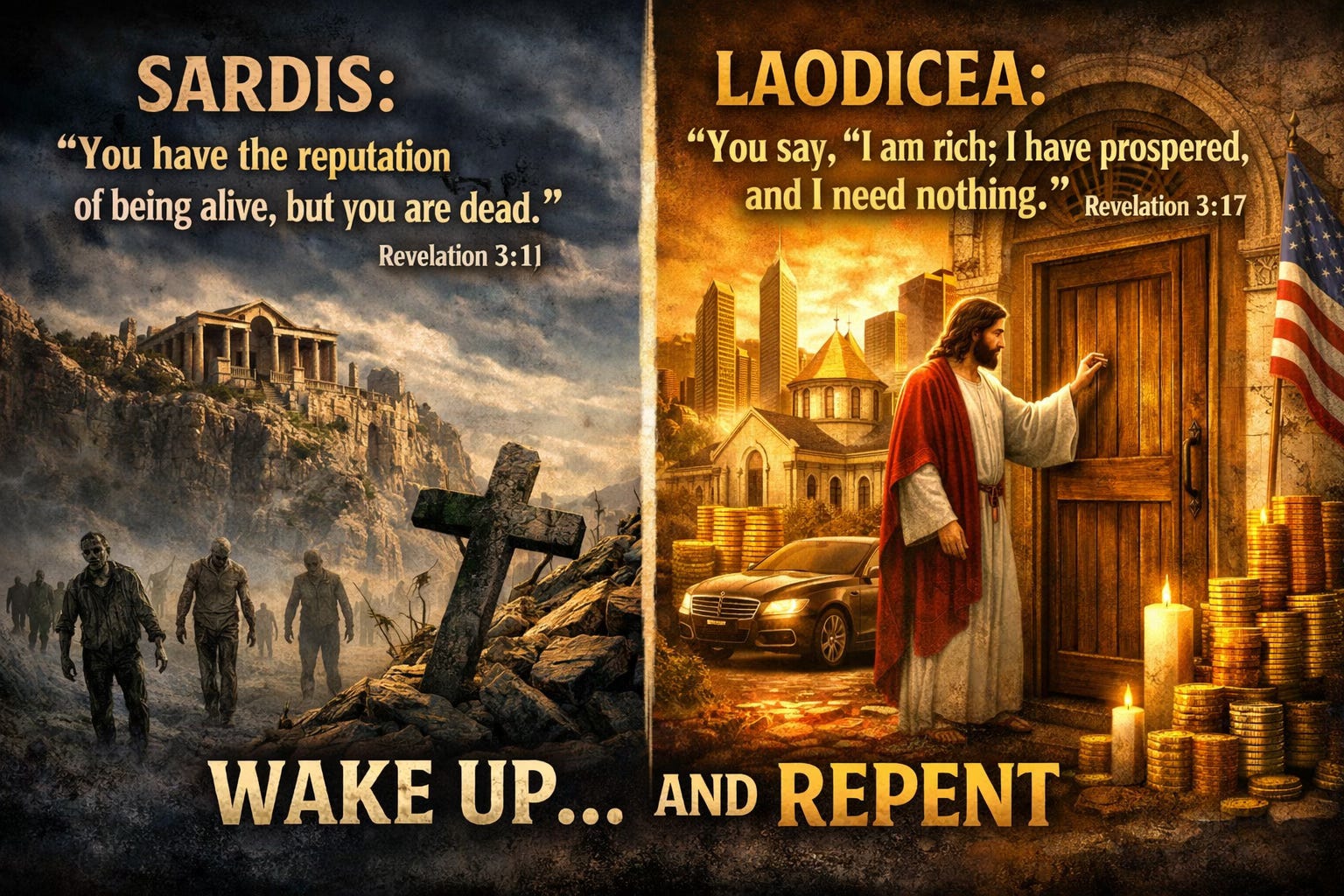
The Church on Life Support
What if your church is not what you think it is? Worse yet, what if you know it is following a dangerous course, but you are reluctant to take a stand or leave?
The message of Revelation 3 is that the most dangerous church is not the one under persecution, but the one that thinks everything is fine, but isn’t.
What if a church can be full every Sunday, patriotic, influential, and culturally respected, yet still be spiritually dead?
Two thousand years ago, Jesus warned two congregations about being dead or deluded.
And his warning may describe many churches in America today.
Jesus is speaking to three of the seven churches of Asia. And when he does, he is also speaking to us.
Listen to what Jesus said to the church in Sardis:
“I know your works. You have the reputation of being alive, but you are dead. Wake up, and strengthen what remains and is about to die, for I have not found your works complete in the sight of my God.” (Revelation 3:1–2)
Jesus is giving them an opportunity to repent, to choose life over death.
Sardis, along with Laodicea, receives no commendation from the Lord. Of the seven churches addressed, he had nothing positive to say about either one. Instead, Jesus warns them that they are near death. His words reveal a sobering truth.
A church can appear vibrant and successful while being spiritually lifeless.
Trading a Cross for a Sword
That is the danger confronting many evangelical and Pentecostal churches in America today. They have traded the cross of God’s kingdom for the sword of empire. Instead of forming disciples who follow Jesus, they have become institutions focused on preserving cultural influence and political power.
Sardis had become a monument to what once was. In many ways, it had turned into a church of zombies—the walking dead. Religious routines persisted, but the life of Christ was fading, and his teachings were being ignored.
Those inside the church didn’t see it. But those outside could sense it.
When the Cross Is Replaced by the Flag
This is where the warning to Sardis speaks directly to the rise of Christian Nationalism.
A church can loudly proclaim the name of Christ while quietly replacing his teachings.
It can display crosses and flags side by side, speak passionately about saving the nation, and pursue political influence in the name of God all while neglecting the primary commands Jesus gave his followers. Christians have been called to love God, love our neighbors, care for the poor, and model a kingdom that is not of this world.
Followers of Jesus inhabit an upside-down kingdom that should avoid worldly power at all costs. God’s kingdom is characterized by humble service, not by a judgmental culture-warrior superiority.
Like Sardis, such churches gain a reputation for being alive. They may be large, loud, patriotic, and politically active.
But secular reputation is not the same as sound, spiritual life.
When allegiance to political power replaces allegiance to Christ, the soul of the church begins to wither.
Jesus’ command to Sardis is blunt:
Wake up!
“Remember, then, what you received and heard. Keep it, and repent. If you will not wake up, I will come like a thief.” (Revelation 3:3)
This warning carried special weight in Sardis because of its history.
The city sat on a nearly impregnable plateau and was considered impossible to conquer. Yet it fell twice because its watchmen failed to stay alert. In 549 BC, Cyrus captured it, and in 218 BC, Antiochus III did the same.
The defenders believed they were secure. Their complacency led to their downfall.
The same danger exists today when churches place their trust in cultural dominance or political power. The kingdom of God has never been protected by the sword of empire. It is sustained by faithfulness to Christ and loving service to others.
A Faith That No Longer Challenges the World
One striking detail: there is no indication that the church in Sardis faced persecution.
Why would it?
A church that has made peace with the world rarely provokes opposition. As the old saying goes, “If you have found your place in the world, the world has found a place in you.”
James warned that friendship with the world makes one an enemy of God. But they weren’t all bad apples.
Fortunately, in Sardis, some faithful believers remained.
“Yet you still have a few names in Sardis, people who have not soiled their garments.” (Revelation 3:4)
In every congregation, there are always a few who choose the way of Jesus rather than following the crowd. Sardis’s only hope was to strengthen what remained.
And that is Christ’s call to many believers today.
Instead of pandering to power, we must speak truth to power. Ungodly means do not justify godly ends. A wrong can never be a right. Ignoring anti-Christian public policy implies approval.
God was willing to give the church another chance because of those who still trusted Him. Today, such believers are typically older. Younger ones are deconstructing their faith.
Why Younger Generations Are Walking Away
The tragedy is that the people of Sardis believed their church was alive when Jesus declared it nearly dead. One difference between Sardis and some of today’s churches is that the people of that city viewed them as harmless.
In the eyes of many of our unchurched neighbors, Christianity represents a threat to freedom and Constitutional protections.
Just this week, there have been multiple reports that military commanders told service members that the war in Iran is an attempt to hasten Christ’s return. To young unbelievers, that is just “crazy talk.” Just because you place immoral actions into a biblical context does not make them godly. Jesus said:
“Not everyone who says to me, ‘Lord, Lord,’ will enter the kingdom of heaven, but the one who does the will of my Father who is in heaven. 22 On that day many will say to me, ‘Lord, Lord, did we not prophesy in your name, and cast out demons in your name, and do many mighty works in your name?’ 23 And then will I declare to them, ‘I never knew you; depart from me, you workers of lawlessness.’ (Matthew 7:21-23 | ESV)
I wonder how many people who believe that we are at war in an attempt to “help God” go to church every Sunday without sensing His presence or questioning why. The music excites them, but they leave feeling entertained, threatened or angry, rather than refreshed.
Many younger Americans are hungry for something real, a faith that changes people. They are not rejecting Christ. They are rejecting a version of Christianity that seems more devoted to maintaining a racist and economic elitist status quo than the world-shaking, life-changing teachings of Jesus.
And so they walk away.
They walk away from churches where the cross has been overshadowed by the flag, where love of neighbor is replaced by fear of outsiders, and where political identity matters more than Christlike character.
It’s a Fiction
A lot has been written recently about young people returning to religion. But the data tells a different story.
In his recent book, The Vanishing Church: How the Hollowing Out of Moderate Congregations Is Hurting Democracy, Faith, and Us (Why the Culture Wars Led to Polarization and What We Can Do About It), Ryan Burge, a sociologist of religion and former Baptist pastor, describes the situation bluntly:
“The past is a foreign country.”
In other words, Americans often misunderstand how dramatically the religious landscape has changed in just a few decades.
Despite headlines about a religious revival, the underlying numbers show little evidence that Christianity is rebounding.
The trends are stark:
44% of Generation Z claim no religious affiliation
Only 40% say they believe in God without doubt
Millennials are only about 40% religious
Despite the president’s claims to the contrary, we are rapidly becoming a post-Christian nation. And much of the problem is dead or deluded churches.
Baby Boomers remain the most religious generation alive today. They currently make up between 40% and 50% of many congregations. However, many are being misled by Fox News, which was fined for knowingly broadcasting lies. Tucker Carlson called Fox a propaganda machine that manipulates elderly viewers.
That news outlet often frames politics using religious language, presented by women who prominently wear silver or gold cross necklaces.
Unless we wake up, when the Boomer generation passes away, the number of religious “nones” will rise dramatically, and we may see more church buildings turned into commercial space.
In the 1970s, most evangelicals identified as Democrats. By the 1990s, their political views had become more diverse. Fox News was launched in 1996 and may have influenced a shift in evangelical party affiliation. Today, white evangelicalism and Republican identity have effectively merged.
This political shift and cable news propaganda have transformed many churches into echo chambers of ideology. Political tolerance within congregations has decreased significantly. Churches now mainly serve a horizontal role, building social and political identities, rather than a vertical one centered on God.
I read a social media post the other day that read, “If your God hates the same people that you do, you are in a cult.”
Homogenized Congregations
Someone smarter than me observed that the most segregated place in America is the evangelical Sunday morning church service. Today, it is both politically and racially segregated.
And that is not God’s Kingdom on earth.
Burge argues that what is disappearing is not Christianity itself, but moderate Christianity. Churches have become politically homogeneous, mirroring the polarization of American communities.
Instead of encountering spiritual, political, and racial diversity, people now choose churches the way they choose cable news. They look for places where everyone already agrees with them. There is no room for discussion, much less debate or disagreement.
When rigid “us versus them” boundaries dominate church life, evangelism becomes nearly impossible. Faith becomes a tribal identity rather than a spiritual commitment. There is no room for the imago dei when we all look alike and look down our noses at those who are different.
It is easy to demonize people you never truly know, especially when our news sources and even some pastors reinforce the message that the church is under threat. It may be because of our politics, rather than our gospel.
Homogeneous congregations form, suspicion of outsiders increases, and faith becomes a tribal marker rather than a spiritual commitment.
The average American, Burge notes, does not hold a coherent or deeply thought-out view of either politics or religion. He found that people who leave the church do not cite a clear theological reason for doing so.
People dismiss what they don’t want to hear by “voting with their feet,” regardless of whether what they heard was grounded in Scripture or not.
Turning on Their Own
Probably one of the most visible recent examples of politics becoming a test of faith occurred when John Piper quoted Leviticus 19:34.
“The foreigner residing among you must be treated as your native-born. Love them as yourself, for you were foreigners in Egypt. I am the Lord your God.” (NIV)
Suddenly, he was “woke.” The movement he helped found turned on him because their brand of “Christianity” has no room for Scripture that warns against the political message that has replaced Christ’s love with fear and “culture war” intolerance.
I can only imagine what might have happened if he had quoted Jesus from Matthew 25 about feeding the hungry, giving water to the thirsty, welcoming the stranger, clothing the naked, and visiting the sick and imprisoned.
From Evangelicalism to Fundamentalism
Burge’s most sobering observation is that modern evangelicalism has begun to resemble the very thing it was originally created to oppose: fundamentalism.
According to him, its defining characteristics are familiar:
absolute certainty
no room for doubt
homogeneous congregations
pressure to agree on everything
hostility toward compromise
suspicion of outsiders
Ironically, evangelicalism originally arose to resist this kind of rigid thinking.
Yet today, many churches operate in the same way. Some argue that evangelicals and Pentecostals are prone to authoritarianism because of the paternalistic leadership in their congregations.
Laodicea and the Illusion of Strength
If Sardis was the dying church, Laodicea was the deluded one.
Laodicea believed it was thriving. Jesus said the opposite.
“You say, ‘I am rich; I have prospered, and I need nothing,’ not realizing that you are wretched, pitiable, poor, blind, and naked.” (Revelation 3:17)
The city itself was wealthy and proud of its independence. But that prosperity created a spiritual illusion. Their wealth had made them self-sufficient. They really didn’t see a need for God’s involvement in their daily lives. They believed their success proved their strength.
They no longer modeled life in the kingdom of God, including reliance on Him.
This is where Laodicea speaks powerfully to the American church.
Religious pride has replaced humility in some American congregations. They have become modern-day, culture-war Pharisees. Many self-professed Christians today are no longer learning to walk in the servant footsteps of Jesus. Instead, they have adopted the swagger of an imperial soldier imposing their beliefs on others.
They criticize the violence of abortion but cheer as we send our military into sovereign nations without clear justification. They celebrate deporting people whose only crime is misdemeanor illegal entry, working people seeking a safer, better life.
The Great Replacement is discussed openly. It is no longer a whispered, racist “dog whistle” conspiracy theory. Some are even hearing it preached from the pulpit.
They do their own judging. They don’t need God.
The teachings of Jesus are too “woke” for modern America.
Christian nationalism assumes the health of Christianity is measured by cultural power, political influence, and national prominence.
But the message of Laodicea reveals something unsettling.
Prosperity and Influence Can Mask Spiritual Decline
A church can be culturally powerful and spiritually bankrupt at the same time. And the same may be said about influential “Christian” leaders.
Many have wagged their moral fingers at prior presidents, yet excused the criminality and moral misconduct of this one. They do it because, so far, he is willing to protect their white privilege.
In his book The Kingdom, the Power, and the Glory: American Evangelicals in an Age of Extremism, Tim Alberta shows that compromised religious figures are not new. And they often resort to eisegesis, twisting Scripture, to sell their message.
Crusades and Inquisition, the slave trade and sexual abuse scandals—the common denominator has been a willingness on the part of Christian authority figures to distort scripture for what they perceive to be some greater good. (p.231)
I have been amazed by the interpretive razzle-dazzle some influential religious leaders have employed to explain away the passages from Leviticus and Matthew on the treatment of undocumented and marginalized people.
The Church That Left Jesus Outside
Jesus then offers one of the most misapplied verses in the Bible:
“Behold, I stand at the door and knock.” (Revelation 3:20)
This verse is often used to invite non-believers to accept Christ. But in context, Jesus is speaking to the church in Laodicea and America.
He is standing outside.
The church bears Christ’s name but has pushed him outside the door.
And yet there is still grace. It is not too late.
“Those whom I love, I reprove and discipline. So be zealous and repent.” (Revelation 3:19)
God is not finished with them yet.
The Warning for the American Church
The greatest threat to the church today is not persecution.
It is self-deception.
Christian nationalism tells believers that Christianity is strong because it is visible in politics, dominant in culture, and defended with national pride.
It calls itself rich while actually being poor.
It claims clear vision while actually being blind.
It clothes itself in patriotism while standing spiritually naked before God.
The greatest danger isn't hostility toward Christianity. It's churches that fail to see they've traded Jesus for the golden calf of secular power. In doing so, they've abandoned the Great Commission and Great Commandment: to make disciples and to love God and love others.
It's a church that thinks it already has everything it needs but doesn’t realize that Jesus is missing. He's standing outside its ornate doors, patiently knocking and seeking readmission.
So, What Do We Do?
The solution for churches that have lost their way is found in the church in Philadelphia, one of the two churches Jesus did not criticize.
That body realized that it had little power, making it dependent on God. And that is exactly where we, his children, are supposed to be. He told Paul, “My power is sufficient.”
Jesus told the congregation in Philadelphia:
“I know your works. Behold, I have set before you an open door, which no one is able to shut. I know that you have but little power, and yet you have kept my word and have not denied my name.”
Your life is your testimony.
You have been given an open door to share the Good News.
No one expects you to stand on the street corner, pounding your Bible and preaching a “turn or burn” gospel message.
But when you have the opportunity to share your story, do it. You don’t need to quote Scripture. The unbeliever doesn’t care what the Bible says, but they are all ears when you talk about how Jesus walked with you through a tough time and provided hope in your darkest moments.
Don’t Give Up
Jesus ends with an exhortation to persevere and a promise for those who do. To quote the immortal words of that famous theologian, Yogi Berra, “It ain’t over ‘till it’s over.” Jesus tells us the same thing. It is not the fastest or flashiest.
It is the one who holds to Christ’s teaching and does not compromise with the world. But the one who endures to the end will be saved. (Matthew 24:13 | ESV)
Thank You
This is the final installment in this short series. Thank you for supporting me. I will never charge for what I post and only ask that you like and share those essays that resonate with you. If you are not a free subscriber, please consider becoming one.
I’ll end with an Old Testament blessing:
The Lord bless you and keep you;
the Lord make his face to shine upon you and be gracious to you;
the Lord lift up his countenance upon you and give you peace. (Numbers 6:24-26 | ESV)